Critics say government's eleventh-hour crackdown relies heavily on teachers' visual inspections rather than technological safeguards, raising doubts over how effective it will be
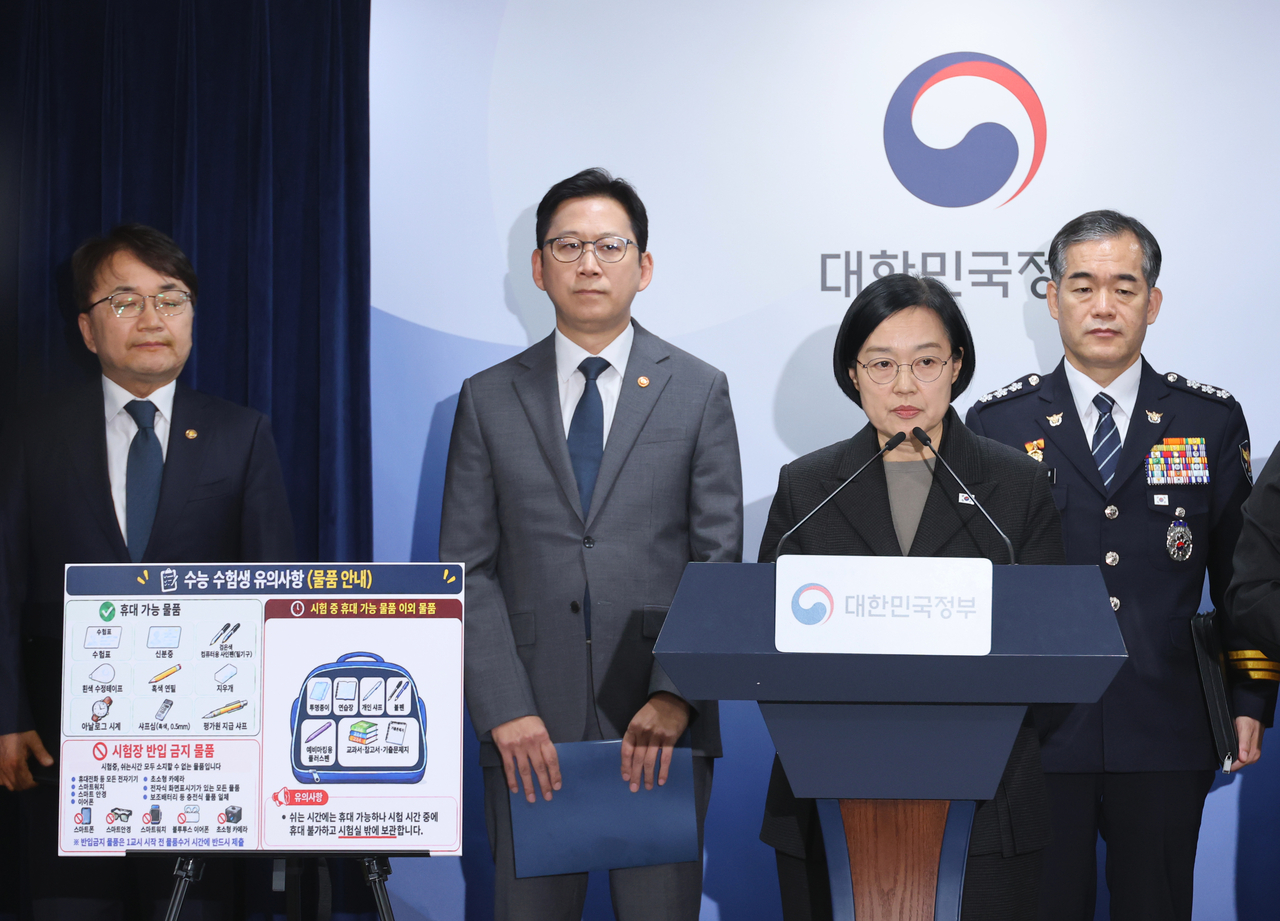
The South Korean government announced a series of measures Tuesday to curb AI-assisted cheating during Thursday’s high-stakes college entrance exam, two days after the top scorer on a national qualification exam admitted using artificial intelligence to cheat.
“The government is doing its utmost to prepare for the exam so that all test-takers can perform to the best of their abilities in a fair environment,” Prime Minister Han Seong-sook told reporters at an interministerial briefing ahead of the College Scholastic Ability Test, or Suneung.
The measures include deploying about 8,400 additional staff, checking test-takers’ glasses and clothing for hidden devices and sending an emergency alert before the exam to detect phones that have not been handed in.
The government also outlined plans to restrict Wi-Fi access at test sites and seek tougher penalties for cheating.
The measures follow a cheating scandal involving the top scorer on this year’s national tax accountant exam.
Han Won-seok, 34, said in a video released Sunday that he had used a miniature camera to photograph exam questions, sent the images to generative AI and checked the answers on a smartphone.
He said he had used the method in both stages of the exam. He appeared for police questioning as a suspect Tuesday.
Government to deploy about 8,400 additional staff
Han said the government would add about 8,400 staff to the roughly 75,000 proctors already assigned to 1,312 test centers nationwide.
Of the additional staff, about 1,800 will be assigned to check for smart devices and about 6,600 will serve as hallway proctors. Test-takers will be required to leave their bags in hallways outside exam rooms, where proctors will check for electronic devices that may have been left switched on.
“If suspicious circumstances arise during inspections, proctors will be allowed to use metal detectors to search for miniature cameras or other smart devices,” Han said.
Tighter checks on test-takers and belongings
Before the first testing period, test-takers wearing glasses will be required to take them off and place them on their desks so proctors can check for smart features.
Proctors will also inspect watches, check collars and sleeves for hidden devices and cover clothing buttons with stickers. Test-takers will be asked to roll up their sleeves for the checks.
Han said another round of smart-device inspections would take place after lunch, before the third testing period.
Proctors will check glasses before each testing period, though test-takers will only have to remove them for the initial inspection.
Test-takers who bring electronic devices, including smartphones, must switch them off and hand them in before the first testing period.
The devices will be kept at each test center’s exam headquarters and returned after the exam. Keeping a prohibited device without handing it in will be treated as cheating regardless of whether it was used.
The Education Ministry said proctors could use metal detectors when they had reason to suspect a hidden device. It said there was no legal basis for blanket searches without test-takers’ consent and warned that such searches could infringe on their rights.
Han said an emergency alert would be sent before the exam to help proctors detect phones that test-takers had failed to hand in, including any left in bags. Asked whether users could disable the alerts, an Interior Ministry official said users cannot opt out of the highest-level emergency alerts.
Education Vice Minister Choi Eun-ok said the extra checks would not change the schedule. Test-takers must arrive by 8:10 a.m., and the exam will begin at 8:40 a.m. She said regional education offices had agreed to keep those times.
Teachers question last-minute staffing and checks
The Korea Herald confirmed Tuesday that teachers at schools across Seoul had received notices saying additional teachers could be dispatched to test centers “upon an urgent request from the education office.”
Teachers’ organizations said the last-minute measures would add to teachers’ workload and questioned whether proctors could reliably spot increasingly sophisticated devices.
“Can proctors really develop the expertise needed to detect increasingly sophisticated AI-assisted cheating simply by being urgently recruited two days before the exam, trained tomorrow and deployed the following day?” the Korean Federation of Teachers’ Associations said in a statement.
The federation also said checks of collars, sleeves and buttons could lead to complaints of inappropriate physical contact, particularly during inspections of female test-takers.
The Korean Teachers and Education Workers Union said recruiting additional hallway proctors two days before the exam had disrupted schools, which would have to rearrange classes and other duties.
Officials said the measures were intended to ensure a fair exam and addressed concerns that the checks could be excessive or applied inconsistently across test centers.
“Some may argue that these measures are excessive, but I believe the social disruption that would result if the Suneung were not conducted rigorously and fairly would be worse than a disaster,” Choi said.
Wi-Fi restrictions and cooperation with tech firms
Han said the government would work with local authorities, education offices and telecommunications companies to limit Wi-Fi access at test sites and look for unauthorized communications.
Science Minister Bae Kyung-hoon said authorities were preparing to shut off school Wi-Fi and nearby public networks that could be accessed from test centers.
Authorities also plan to check for portable Wi-Fi routers because they cannot shut down all private networks. Mobile data connections would remain available.
The government plans to work with telecommunications companies to review connection records during exam hours when investigating suspected cheating.
It will also seek help from global technology companies in examining cases in which test-takers are suspected of photographing questions and using AI to obtain answers.
“We will cooperate with global tech companies, which have expressed their willingness to assist with subsequent investigations if there are suspected cases of students photographing exam questions and using AI to obtain answers,” Han said.
The government did not disclose which companies it had approached.
Government seeks tougher penalties
Han said the government would operate a dedicated reporting center to receive tips about suspected cheating and pledged to take “a zero-tolerance approach” to violations.
The government said it would work with the National Assembly to extend the Suneung ban for cheating from one year to 10 years and seek to apply the longer ban to violations on this year’s exam.
Authorities said they would also file criminal complaints against those found to have used smart devices to cheat, alleging obstruction of official duties by fraudulent means. The offense carries up to five years in prison upon conviction.
The government said it had consulted the Korean Council for University Education on revoking the admission of students found to have gained entry through cheating.
Test-takers already enrolled at a university could also face expulsion from their current institution.
The government said it would pursue a separate proposal to bar those found to have cheated from university admission for 10 years.
In a separate statement, the council said universities would apply the same strict principles to cases involving AI or smart devices used to cheat on entrance exams administered by universities.
Authorities also pledged legal action against people who encourage cheating or spread false information about the Suneung.
The government said it would investigate businesses selling smart devices that could be used to cheat, including miniature cameras.
The main opposition People Power Party criticized the government for failing to detect cheating in the national tax accountant exam and said it would submit parliamentary motions recommending the dismissal of Prime Minister Han and Education Minister Choi Kyo-jin. Both the PPP and the ruling Democratic Party of Korea said they would introduce legislation to toughen penalties for cheating.
seungku99@heraldcorp.com